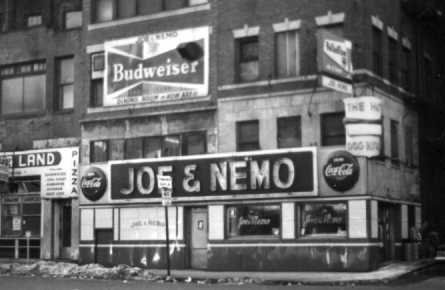
Joe and Nemo, circa 1950Boston's most famous restaurant actually began as a barbershop.
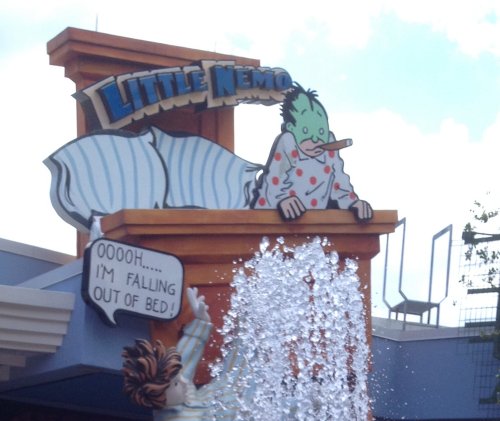
Joe Merlino, a first generation immigrant from Italy, owned a barbershop on Stoddard Street, just across Howard Street from the Old Howard theater. Outside, on the street, Joe's friend Izador "Izzy" Schenker sold hot dogs from a steaming kettle. In 1909, tiring of hirsute pusuits, Joe bought the Dowd Brothers bar, located next to the barbershop, and invited Izzy to move his hot dog stand indoors. When Izzy grew tired of the bar and left, Joe invited Anthony Caloggero, who had worked alongside Joe at the barbershop, to take Izzy's place. Anthony was known by his nickname, Nemo, which was given to him by his parent because he reminded them of the the boy in a comic strip called "Little Nemo," who was constantly getting into trouble. When Nemo joined the business the two men decided to name their hot dog emporium/bar after themselves. And that is where we get the name Joe and Nemo.
Joe and Nemo were not related when they started the business in 1909, though it was staffed by family members from both partners, such as Nemo's brother, Samuel. In 1919, Anthony - that's Nemo - married a girl named Susan Loverde in a ceremony in which Joe was the best man and Susan's sister, Lillian, was the Maid of Honor. A year later, another wedding made Joe & Nemo's a one family business when Joe married Lillian. This meant that Joe and Nemo were not only partners but each other's brother-in-law, too. (Cynics might suggest this makes the longevity of their enterprise even more remarkable...)
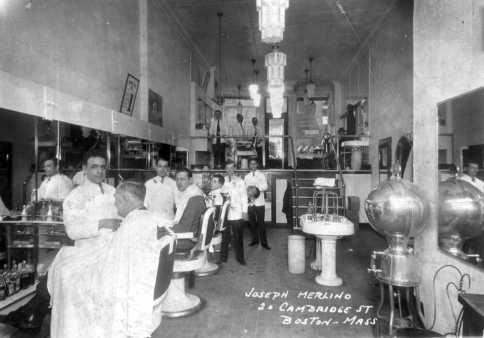
The original Joe and Nemo - barbershop, that is!When Prohibition arrived in 1920 Joe and Nemo had to close the bar. To make up for lost business they opened a restaurant on Stoddard Street, which ran from the front entrance of the Old Howard to Cambridge Street. The restaurant wasn't the biggest in Boston - in fact it may have been the smallest - so small that the two men actually had to sell their hot dogs outside the store, even in winter. Many West Enders still recall Anthony "Doc" Lopez, the man who served them hot dogs from a steaming cauldron on Stoddard Street.
In 1928, in an effort to alleviate congestion from increased automobile traffic, the city widened Cambridge Street, which cut Stoddard Street in half. Joe & Nemo's, once located in the middle of Stoddard Street, was now at the corner of Stoddard and Cambridge Streets, and since Cambridge Street was one of Boston's major thoroughfares (this is L-O-N-G before the Central Artery), the restaurant's popularity increased.
One All Around
In 1933, when Prohibition was repealed, Joe and Nemo applied for and got one of the first liquor licenses issued in the city. A few years before, Joe had bought the building next to the original location on Stoddard Street. Now that Prohibition was over they broke through the wall to make a bar and dining area on the second floor. Prices were low everywhere because of the Depression, but here one found food that was not only cheap, but good, too. A steak dinner was only thirty-five cents. So was a full breakfast consisting of eggs, bacon, home fries, toast, and coffee. But the main reason for going was still the hot dogs. What was it about those things that made them taste so good?
First of all, it was the dogs themselves, made from a special formula by the New England Provision Company (NEPCO). Secondly, it was the way they were cooked. Ed Insogna explains:We steamed the rolls and cooked the dogs in water. We did not boil the dogs, never! The skin breaks and that releases the flavor into the water and the dogs don't taste as good. That was part of the secret. People could buy the dogs [uncooked, to take home] and they would come back and say "they don't taste the same." That was probably why.

The Howard Trick and Joke Shop, around the corner from Joe and Nemo, circa 1930Thanks to the inexpensive food and great location, Joe & Nemo's soon became one of the most popular places to eat in Boston. Joe and Nemo, both interviewed in 1953 by the Boston Herald's "Roving Eye," Rudolph Elie, indicated just how popular the place was. First, Joe:
We got three shifts going with 78 men and nine cooks on the jump. we close only for an hour and a half a day, too, shutting down at 3:30 in the morning and opening up again at five and that's only to clean up. Nemo added “I guess we're in an institution. People come from all over. They heard about us from some sailor or somebody somewhere, and they gotta have "one all around" (Boston Herald, November 20, 1953).What does "one all around" mean, anyway? Joe's son Frank has been asked that question many times. For the uninitiated, he explained the expression to the Boston Post one day:When my dad first opened up he used to serve hot dogs with mustard, relish, onions and horse radish. But it takes a long time for a customer to order a hot dog with mustard, relish, onions and horse radish. So they just made that up to save time. The horse radish was eventually dropped from the all-around because, as Frank explained, "the younger generation doesn't care for it."The article continued:But Frank admits he lives in fear of the day when some really old Bostonian will wander down from the Odd Volumes Club, order one all around, bite into it and then bellow: "What, no horse radish?" (Boston Herald, February 7, 1944).Servicemen swarmed to Joe & Nemo's. A big reason was that when liberty time brought them into Boston the one thing they did not want to do was spend a lot of time or money on dinner. Lonely months at sea had given them other priorities, so Joe & Nemo's was the perfect place to go, especially with the Old Howard just a few feet from the front door. This created a loyalty that servicemen of all branches carried with them all over the world. Strangers who meet on a battlefield usually began a conversation by exchanging hometowns. Those who called Boston their home were often met with the reply of, "Boston! Boy, could I go for a Joe & Nemo's hot dog right now!" Legend has it that Joe & Nemo's was the site of several "reunions" for soldiers and sailors who met in the heat of battle during World War II. As shells burst overhead, pledges were made to meet at Joe & Nemos on such-and-such a date after the war was over.
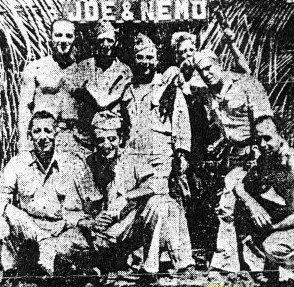
But the prize for loyalty must go to the members of Battery C of the First Battalion of the 211th Coast artillery in Pearl Harbor (shown above.) Outside their thatched "recreation" hut at Pearl Harbor, they eased their homesickness with a reminder of happier times: a sign over the door which said "JOE & NEMO'S"
Joe and Nemo and the end of Scollay Square
In 1955, partly in response to slackening business in Scollay Square (the Old Howard Burlesque theater had been closed by the city in 1953 and the residents of the West End were slowly being evicted from their homes), Joe & Nemo's began to open new restaurants in other locations. By the early sixties there were twenty-seven restaurants serving over a million hot dogs a year throughout the greater Boston area and in Florida as well. Expansion turned out to be the key to survival, because the scheduled razing of Scollay Square was to include all of Stoddard Street. In 1961 the city informed Joe that his building would be taken by eminent domain. Ed remembers bitterly that "the eighteen thousand dollars for the property barely paid for our moving costs to Summer Street."
This was the great era of redevelopment in Boston as the West End, Scollay Square, the Prudential Center, the South End, and other neighborhoods and business districts were being remade by a city desperate to stave off an imminent slide into urban obscurity.
In June of 1963, almost two years to the day after the Old Howard burned down, the last hot dog was sold at Joe & Nemo's in Scollay Square. It was a sentimental day for the regulars, who showed up to pay their last respects to the original home of the Hot Dog Kings. That night the drinks were on the house for the hundreds who showed up for one last hot dog "all around." There was singing in the barroom and memories gushing out of every corner of the place as the regulars said good bye to another Scollay Square landmark.
Later that night, after the last teary eyed customer had departed, Joe Merlino walked around the store shutting off the lights and the appliances, just as he and his family had done in the same store for fifty-four years. Then he walked out onto Stoddard Street, turned, and for the last time, locked the door.
What better symbol could there have been for such a uniquely American place like Scollay Square than a hot dog stand? And what better symbol of the American dream could there have been than a man like Joe Merlino? It was fitting that he closed Joe & Nemo's restaurant on Stoddard Street for the last time and, in effect, officially close old Scollay Square.
The day I found Nemo...
With the exception of my bio, I try not to insinuate myself into this website, but I have to share this story: In June 2014 I took my family on vacation to Universal Studios in Orlando, Florida. Part of the theme park is "Toon Town" which celebrates the great comics from the past hundred years. Remember that story about how Anthony Caloggero got his nickname from that comic strip? Here he his - Little Nemo himself! (Seems like Scollay Square follows me wherever I go...)