Hello, and welcome to the Scollay Square web site. A brief, pictoral history of Scollay Square is just below and there are lots of other pictures and information available using the links on your left, or by visiting our home page.
History of Scollay Square
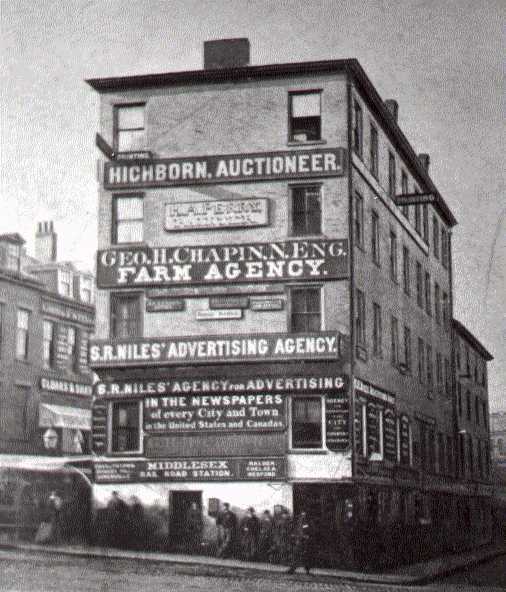
In what is today Government Center, near the traffic island at the intersection of Cambridge and Court Streets, the four-story building shown above stood during the latter part of the 18th century. In 1795 it was bought and named for its owner - William Scollay. Citizens, horse car and stagecoach drivers alike began to call the spot Scollay's Square, and by 1838 the city made the name that everyone was using anyway, official – and Scollay Square was born. (Courtesy of the Bostonian Society / Old State House)
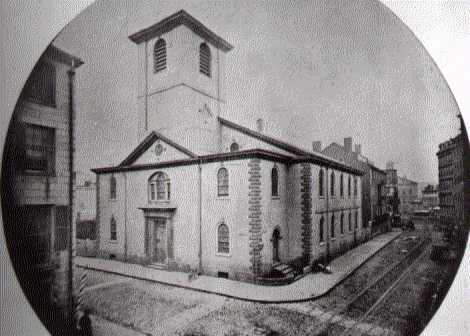
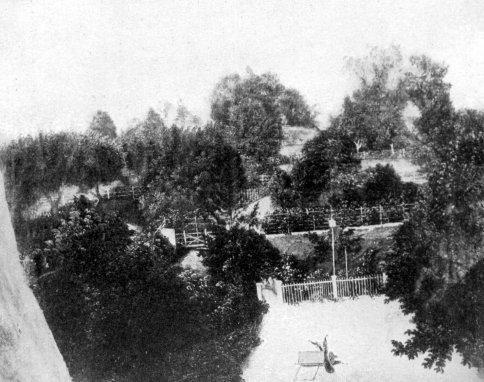
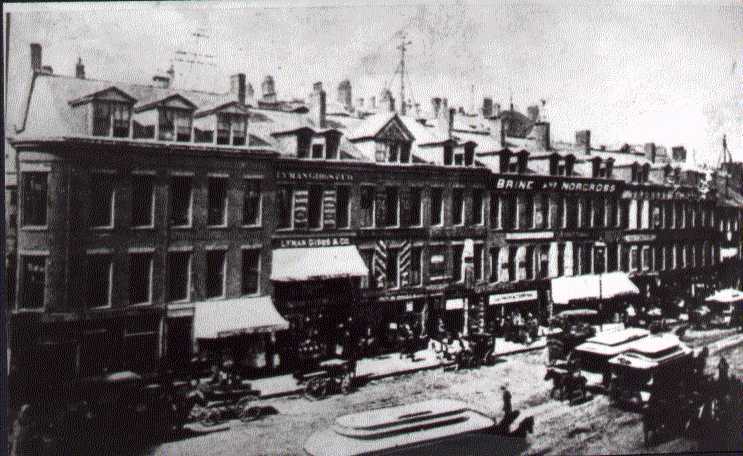
It was from the beginning of Boston’s history home to the elite and ruling class. John Winthrop (the founder of Boston and first Governor of Massachusetts) lived nearby, as did many other city and state officials. During the siege of Boston in 1775/76 the Brattle Square Church housed British troops. Today, this site would be the base of City Hall at City Hall Plaza. (Courtesy of the Bostonian Society / Old State House)Near the base of Cotton Hill (one of the original three Trimountains - Mt. Vernon, Beacon, and Cotton - that were collectively known as Beacon Hill) was the home of Gardner Greene, whose backyard was landscaped into a beautiful terraced garden that was, for many years, a favorite attraction among 18th century Bostonians. (From "One Hundred Years of the Suffolk Savings Bank," pub. 1933)Mr. Greene's home was torn down in 1832 and his backyard (Cotton Hill) was torn down, its dirt used to fill in a part of the Charles River. The now flattened Cotton Hill was christened Pemberton Square, and a neighborhood of bow-front homes were built there. From Howard Street to Beacon Street a row of buildings was constructed and called, appropriately enough, Tremont Row, which was a collection of shops and boutiques. In the 1850s it was home, in a room on an upper floor, to J J. Hawes, one of Boston's first photographers (or daguerreotypists, as they were then known) set up shop. (Courtesy of the Bostonian Society / Old State House)
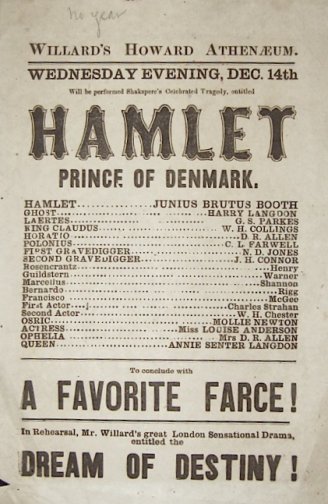
Just around the corner from Tremont Row was Howard Street, where the Howard Athenaeum entertained a generation of Bostonians with some of the finest actors and actresses of the English speaking world, including the great Junius Booth, his upcoming December 14th, 1848 performance being promoted in the above broadside. Junius was head of an entire family of classical actors, including John Wilkes Booth, whose fame would turn to infamy with his assassination of President Abraham Lincoln in 1865.
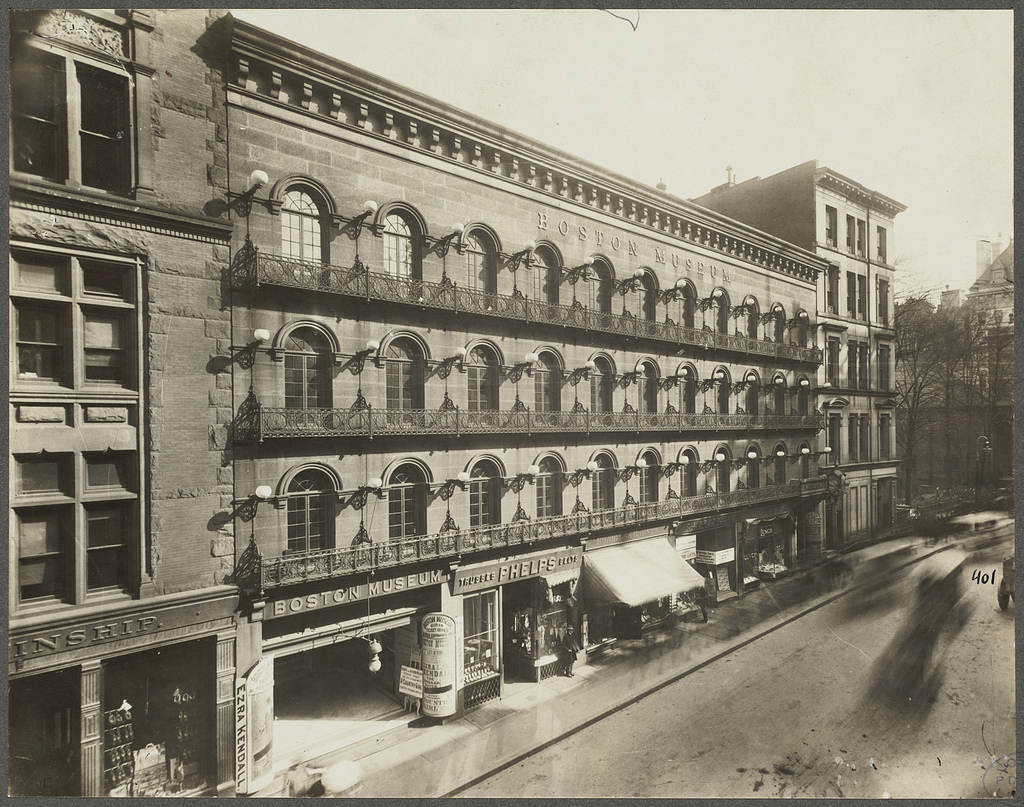
Back on Tremont Street, between School street and Scollay Square was The Boston Museum, founded by Moses Kimball and moved here in the 1850s. As explained in the terrific And This is Good Old Boston website, "The facility actually was a museum, containing stuffed birds and animals, and other natural curiousities. During the 1840s, Kimball became a friend and associate of P.T. Barnum, and often shared exhibits with him. The (in)famous Feegee Mermaid was one of these, a half-orangutan/half fish construction that had a great popularity." But the museum was only part of what made this place one of the more popular attractions around Scollay Square - it also had a full-size theater where Bostonians could hear lectures from such luminaries as Mark Twain and where, according to researchers at Rutgers University, was the first American production of H.M.S. Pinafore in 1878. That production (according to the Rutgers website on a landmark silent film titled "The Headhunters,") featured the musical direction of prominent musician and conductor John Braham. (The Rutgers site also notes Braham was also music director at the Howard around the same time.)
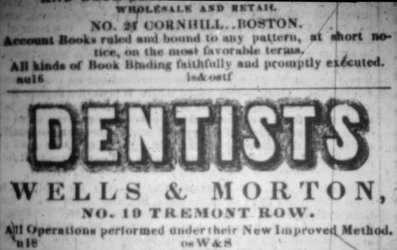
Just across the street from the Boston Museum, was the office of Dr. William Thomas Morton, who is credited by some as the discoverer of ether as an anesthetic. Here he opened the first dentist office to offer “painless” dentistry, and advertised such in the Boston Post in the 1840s. Also note the ad just above Dr. Morton's, for a book binder on Cornhill.
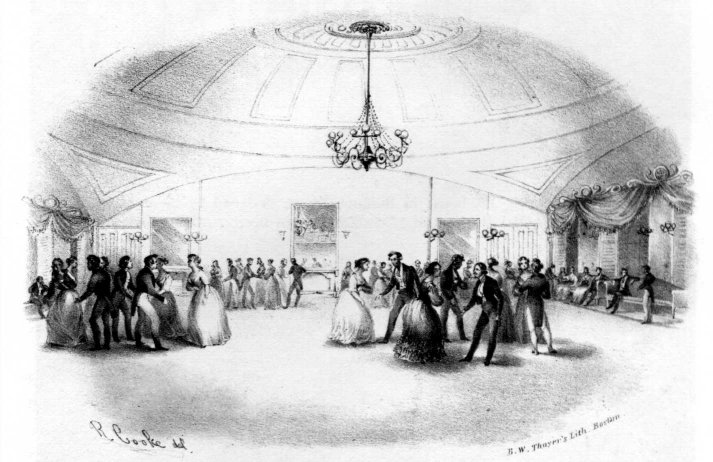
That this section of Boston was , at the time, geared for the well-to-do is underscored by the dance academy opened by Lorenzo Papanti. As described in Cleveland Amory's classic, The Proper Bostonians (E.P. Dutton, 1947) Papanti was "a tall, skeleton thin, fiery tempered Italian Count..." who became a favorite of Mrs. Harrison Gray Otis, who had chosen the Count as her partner to dance the first waltz ever seen in Boston.
Amory wrote that "...By 1837 Papanti has become so successful that he was able to move his academy to a new and palatial quarters on Tremont Street [this side of which was also known as Tremont Row]. Here he built a hall with a $1200 chandelier, five enormous gilt-framed mirrors and the first ballroom floor in America to be built on springs." Amory later wrote that "...it was on Papanti's sprint floor that four generations of Boston's best - from 1837 to 1899, when the hall finally closed - were initiated into the art of the Boston ball beautiful." (pg 262, Proper Bostonians) The Papanti Dance Studio is also where Charles Dickens read from his novel, The Pickwick papers during his first visit to Boston. (Courtesy of the Bostonian Society / Old State House.)
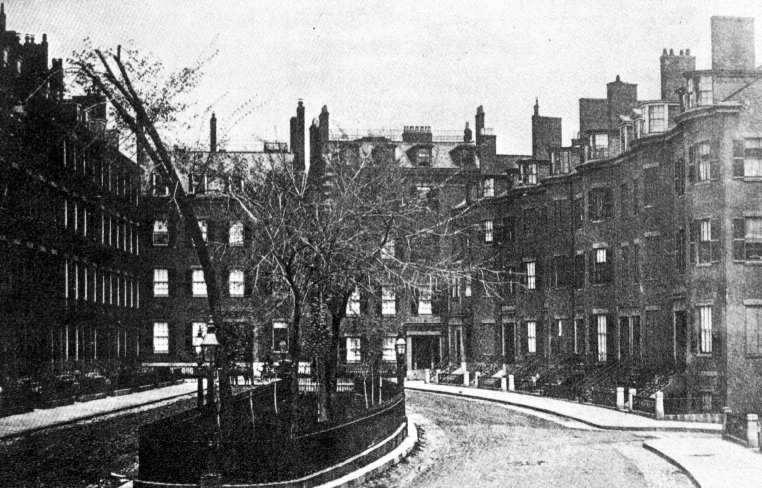
Just behind Tremont Row was Cotton Hill, named for John Cotton who settled there in the early 1600s. In 1832, Patrick Tracy Jackson cut off the top 70 feet of Cotton Hill which he used to fill in an area north of Causeway Street to build a train station. Where Cotton Hill once stood, Jackson built a neighborhood of bow-front homes which he called Pemberton Square, which for many years was THE address for Boston’s elite and well-to-do. (Courtesy of the Bostonian Society / Old State House)
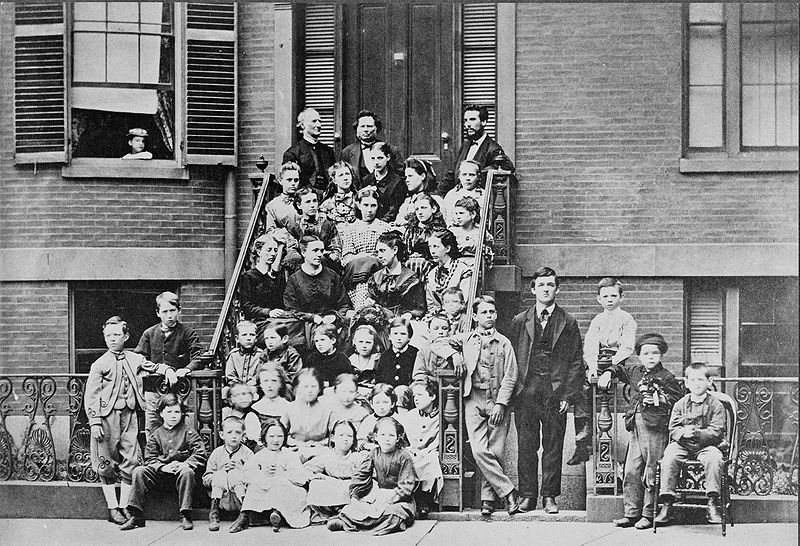
Pemberton Square was site of the The Horace Mann School, the first school for the deaf to be incorporated as part of any regular city public school when it opened in November of 1869. This photograph, taken in 1871 (courtesy of the Library of Congress) shows "Alexander Graham Bell, teacher of teachers, seated on top step with Rev. Dexter King, founder of the school, and Dr. Ira Allen, chairman of the school committee, three steps down are teachers Annie M. Bond, Sarah Fuller, Ellen L. Barton, and Mary H. True, students are seated on the steps and standing on the sidewalk at entrance to the Pemberton Square School (Boston School for the Deaf)" Perhaps it was the school's proximity to Scollay Square that generated Bell's interest in renting space on the upper floor of a building on Sudbury Street where, in 1875, he and Thomas Watson would first hear the sound of a human voice through the device they would develop into the first working telephone.
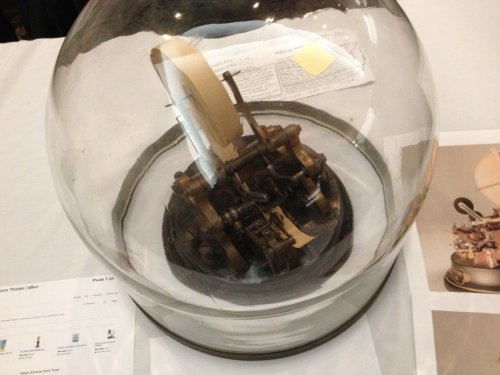
Bell was not the only prominent inventor to work in Scollay Square. In fact, working in the very same laboratory space on Subury Street where Bell and Watson made their breakthrough with the telephone a young Ohioan built his first patented invention, an automatic vote counter. Although the young man failed to sell the device, he persevered and eventually built the prototype for his first money-making invention - the stock ticker. The picture above (taken by David at the annual Antique Radio show in Westford, MA) is of the first production run of the device that started Thomas Edison on the road to becoming one of the world's great inventors. (The owner wanted $5,000 for the ticker, a bit too much out of David's price range...)
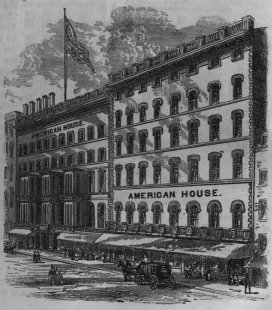
The American House, on Hanover St., was one of the largest hotels in New England, and widely regarded as one of the best during the mid-1800s. Rebuilt in 1851, it featured a grand dining room capable of seating more than three hundred people. It was written of the ballroom that "when lighted at night it is one of the most brilliant halls in Boston, having at either end mammoth mirrors reaching from the floor to the ceiling." The hotel was actually built on the site of four older hotels, Earle's, the Merchant's, the Hanover, and the old American House.
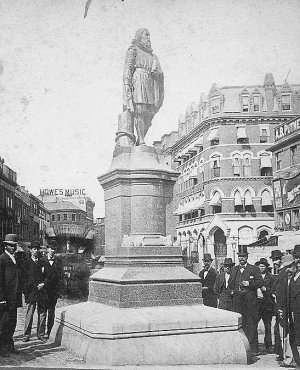
On September 17, 1880, a statue of the first governor of Massachusetts, John Winthrop, was dedicated in Scollay Square. Sculpted by Richard Greenough, it was a duplicate of the statue that had been placed in the U.S. Capital. That the city chose Scollay Square as the site for such an important piece of public art speaks volumes about its stature of Square in Boston at the time. Read more about the statue in Francis Bremer's web essay "Remembering–and Forgetting–John Winthrop and the Puritan Founders." There is also this Boston Globe column by Sam Allis which looks an amusing look at the saga of the statue...
When the Irish came to Boston in the 1840s they settled first in the Fort Hill and North End neighborhoods, then into the West End. The Irish – and other ethnic peoples that followed in the mid- to late-1800s, changed the character of Boston. (Courtesy of the Bostonian Society / Old State House)
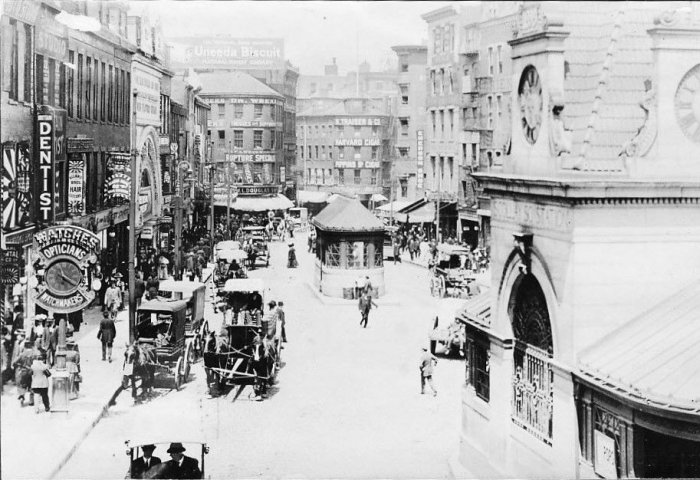
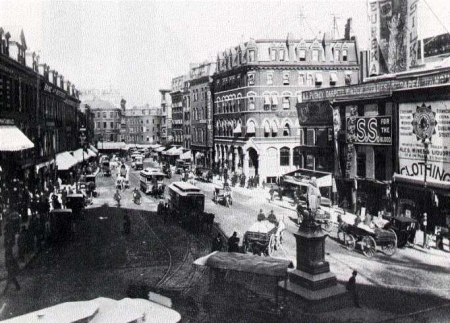
As the elite abandoned the West End and Scollay Square and moved further up Beacon Hill and into the Back Bay (which was under construction beginning in the 1850s), Tremont Row and the surrounding businesses in Scollay Square adapted to meet the needs of the immigrant class. The Square became, by the 1880s, a commercial center of Boston. Here's a grand shot of Court Street in 1905 simply bustling with actvity.
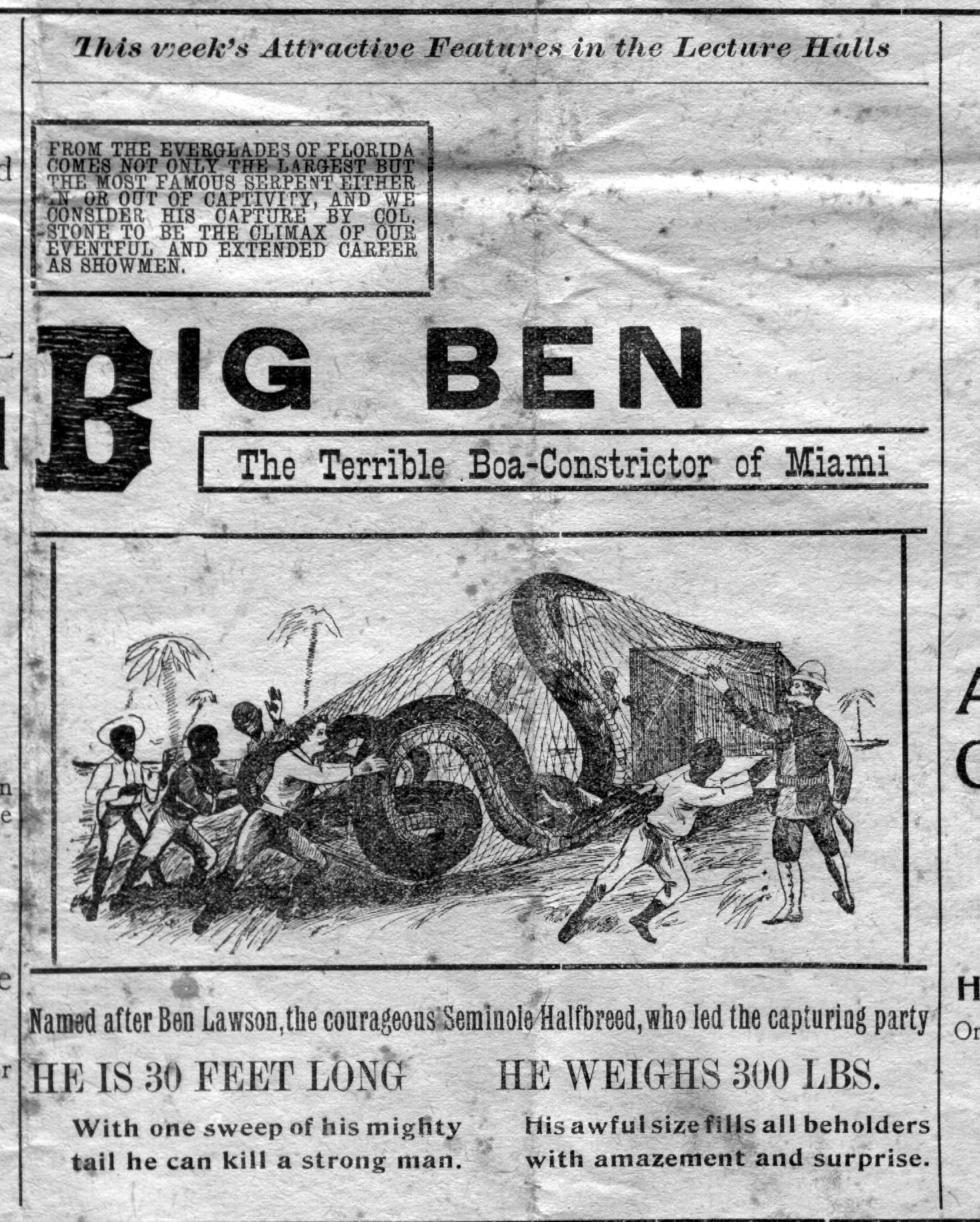
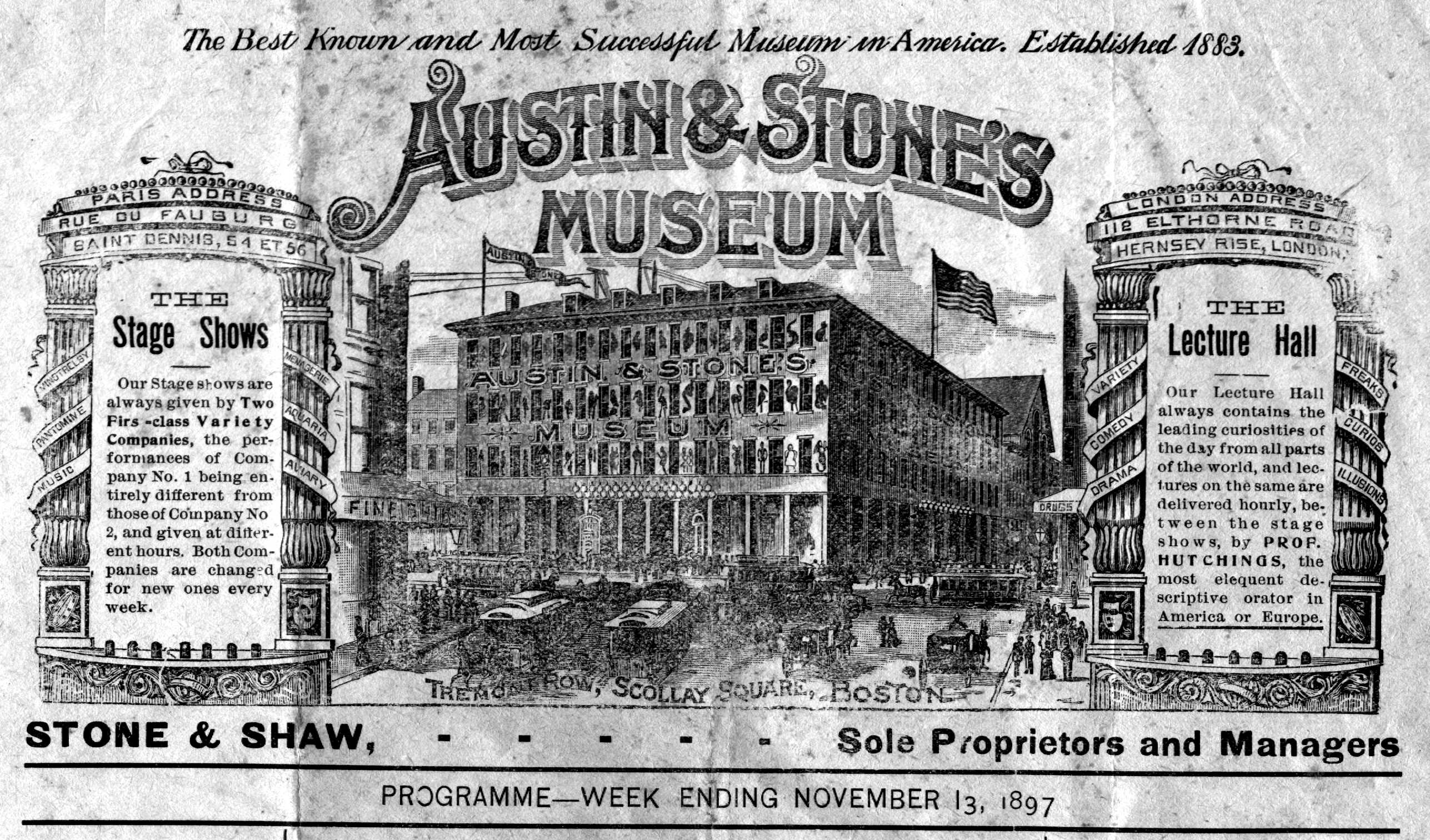
Among the commerical actvity that thrived here were restaurants, bars, and theaters. With the success of The Old Howard came other venues, such as Austin and Stone’s Dime Museum, which opened on Tremont Row in 1881 and was a mainstay in Scollay Square until it was torn down in 1912 to make way for the Star Theater. Click on the thumbs above to see full-size views from a promotional handout for the theater.
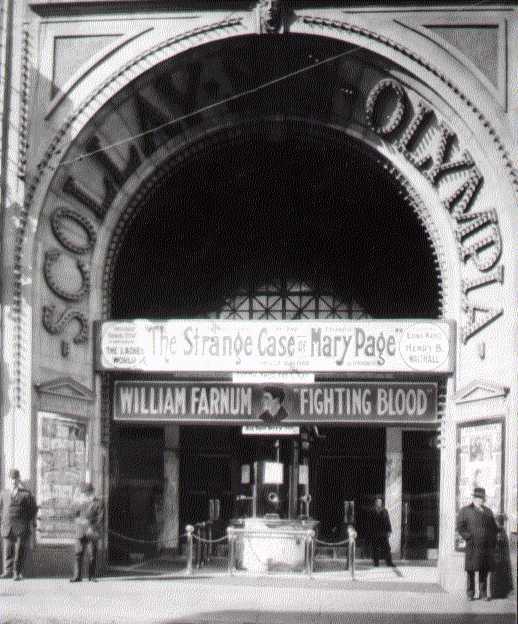
Built in 1914, Scollay Square’s Olympia was a popular theater where performers such as Milton Berle performed. Weber and Fields, Fanny Brice, Fred Allen, the Marx Brothers, George Burns, and many others were mainstays of live stage shows at this and other theaters, but even the most traditional theater owner had to bow to the new technology and install motion picture equipment, although live stage shows continued to supplement the bill of fare well into the 1930s.
According to a 1989 Boston Globe "Ask the Globe" column, "In 1927 the Scollay Square house announced it had created the 'finest of health zones' with the introduction of then-novel air conditioning. 'You could pay many thousands of dollars to spend a vacation at a camp or resort that has the good effect and curing powers that you can get at the Scollay Square,' the theater advertised. In 1935, in the aftermath of owner Nathan Gordon's death and the purchase of the house by Martin Mullins and Sam Pinanski, vaudeville gave way to motion pictures." The Olympia closed in December, 1950 just three years before the Old Howard was shuttered for good. (Courtesy of the Bostonian Society / Old State House)
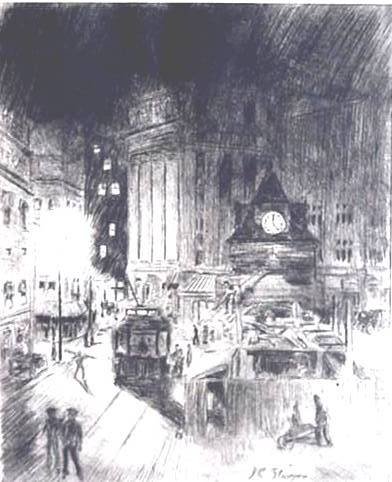
One of the most acclaimed American etchers of the early twentieth century was Dwight Case Sturges, who was born in Melrose and studied at the Cowles Art School in Boston. Sturges made this etching of Scollay Square probably in either 1912 or 1913, when the subway line from East Boston was extended to Bowdoin Square and points north.
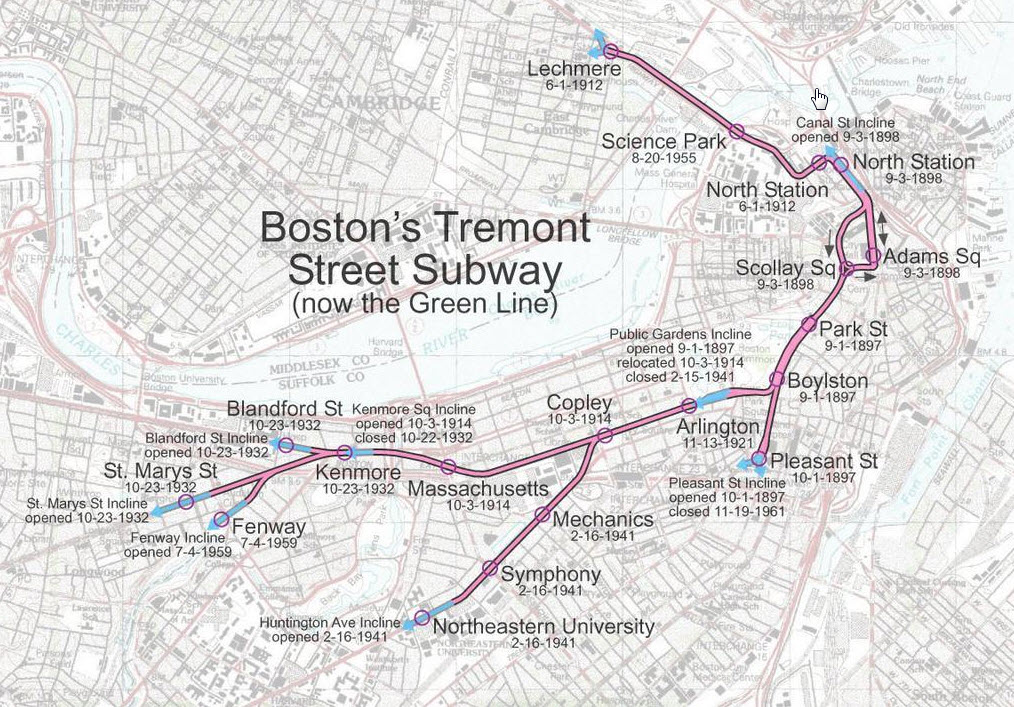
So many great websites and books have and are documenting the history of America's first subway system. Here's a terrific map (grabbed from the MBTA Twitter page (@mbtainfo) showing the critical location of the Scollay Square station - one of the system's first when it opened in 1898.
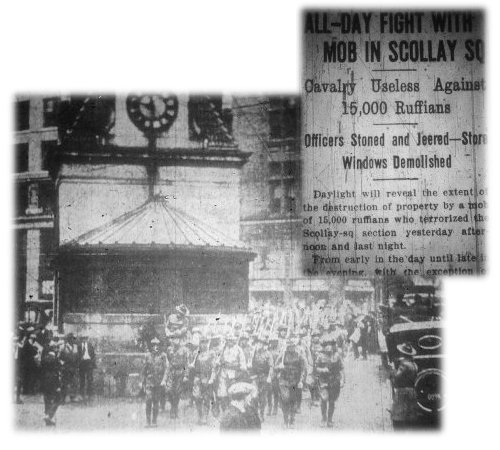
Scollay Square played a large role in the 1919 Boston Police Strike, perhaps none more dramatic than the cavalry charge, ordered by Governor Calvin Coolidge, to disperse the huge mob which had gathered there. The story is told in detail in Always Something Doing. Another great source is Francis Russell's book on the strike, City in Terror.
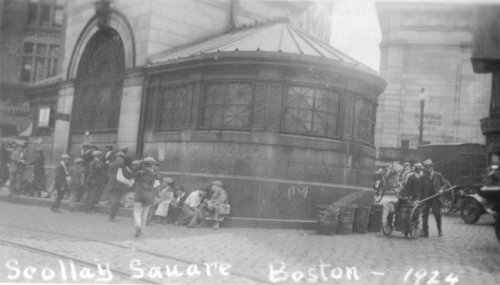
It's 1924 and we are looking at the Scollay Square subway station, surrounded by the newsboys who used to gather there to collect their papers before setting off to "hawk" them at city corners. This gathering point was known to the paperboys as "the Canada Point" (What does "Canada Point" mean? See this web site for an explanation.)
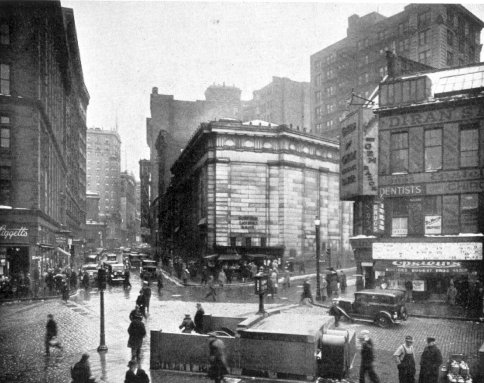
On a rainy day in 1933, someone took a photograph from in front of the Sears Crescent Building looking up Tremont Street. The imposing granite building across from Epsteins Drug Store is the Suffolk County Savings Bank, which was celebrating its 100th anniversary that year. (1933, for those who remember, was not the best timing for a bank to be celebrating anything...) (From "One Hundred Years of the Suffolk Savings Bank," pub. 1933)
Courtesy of the Boston Public Library's Leslie Jones collection, the remarkable picture above shows Scollay Square at its height during the war (note the sailor in the lower right-hand corner near Simpson’s Loan). We're looking north; today City Hall would be on our right and the curved 1-2-3 Center Plaza building on our left. Those wonderful subway kiosks are long gone, but the Square is still a transportation hub. It’s also a highly popular destination, as evidenced by the all the double-parking in front of places such as the Crawford House, Jack’s Lighthouse, and, under the PM Scotch sign, the famous Half Dollar Bar. (The Crawford House was, most notably, the "home" of Sally Keith, whose remarkable act is chronicled her own page on this site.) Just above the Tasty restaurant was Frank Liberty's tattoo parlor, whose story is chronicled here, on the wonderful TattooedBoston.com website.
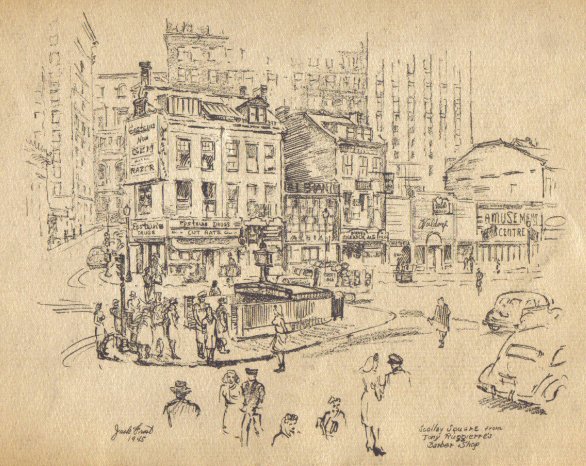
Jack Frost (undoubtably a nom de plume) published a small collection of sketches in a booklet he titled "The Old Home Town" in 1945. The caption of this one says "Scollay Square from Tony Ruggiere's Barber Shop." It's a great view looking towards Tremont Row and Pemberton Square. Note the Amusement Center next to the Waldorf cafeteria.
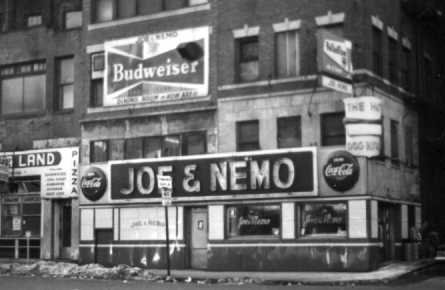
Opened in 1909 by two West End barbers, Joe and Nemo’s hot dog stand quickly grew into one of Boston’s most popular restaurants. It’s proximity to the Old Howard (located just down Stoddard Street to the right of the store) certainly helped, but the store also generated tremendous loyalty by providing good, inexpensive food. (Courtesy of the Trustees of the Boston Public Library)
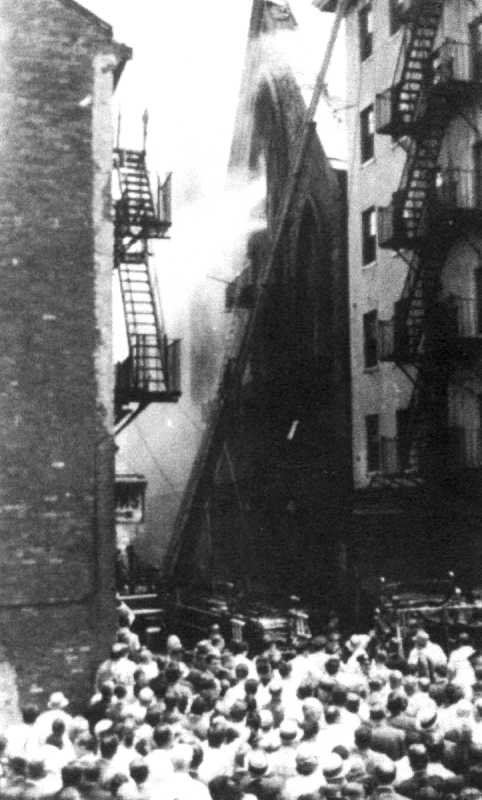
As plans for Scollay Square’s replacement were being formed (this site has two whole pages of photos on the Square's last days and demolition), a group of theaterically motivated citizens, along with Ann Corio and other former Burlesque stars tried to raise money to save the Old Howard from the destruction. But on June 21, 1961, a “mysterious” fire of “unknown” origin (the quotation marks are deliberate – the fire department’s report could find no cause for the blaze) swept through the 115 year-old theater and before the last embers had died out, several cranes moved in and tore down its walls, rendering rennovation impossible. (Author's collection)
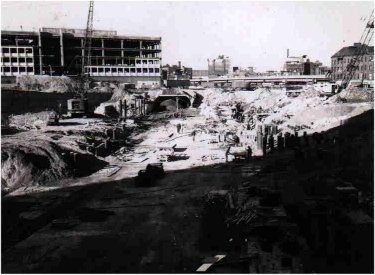
Looking straight up the new alignment of the subway in Government Center. The JFK Federal building rises along what used to be Hanover Street. The elevated Central Artery (which cut off Hanover and other streets from the North End and Waterfront) can be seen in the background. Foundation work for Boston’s new City Hall is about to begin. (Courtesy of Dick Keough)
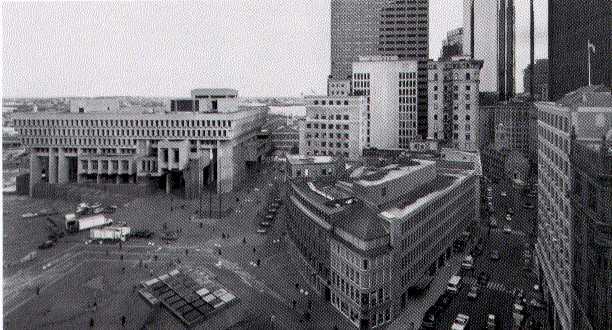
No more tassels. No more hot dogs. No more fun. Government Center replaced Scollay Square in the early 1960s when Boston, desperate to prevent a slide into urban obscurity, secured over $40 million in federal funds to tear down this fading hot spot and replace it with a collection of city, state, federal, and private office buildings. (Author's collection)
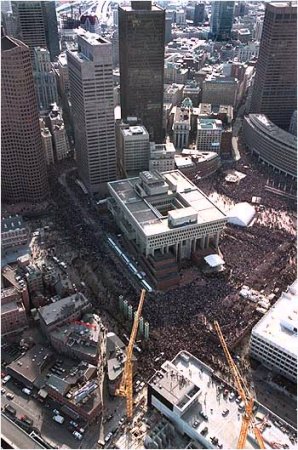
Well, almost no fun. On February 5, 2002 over a million people jammed Boston's streets to watch a parade for the Super Bowl Champion New England Patriots (a tradition that, since the new Millennium began, that the Pats would perform a total of three times, the Sox twice, and once by the Celtics.) All the parades, like the 2002 event shown here, ended up here at Government Center at Scollay Square. If nothing else, the event shows the immense need for a true civic space, and the inadequacy of City Hall Plaza - in its current configuration - to accommodate those needs.